ISSUE 106
SPRING 2026
Website: http://www.gogg.uk/
Email address: glosorgg@gmail.com
DUNDRY NURSERIES MEMBERS’ DISCOUNT
Dundry Nurseries, Bamfurlong Lane, Staverton, near Cheltenham.
Members are entitled to 10% discount on production of the current GOGG Programme Card (which is available from Lorna when you pay your subscription)
The nursery can be contacted on 01452 713124.
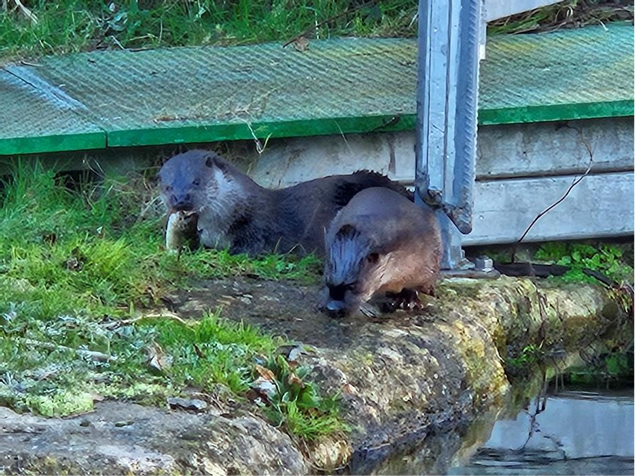
Cover photo: Otters on Stroudwater Canal – Robin Phillips
____________________________
GOGG has associate membership of GARDEN ORGANIC.
Any member wishing to use the Group’s ticket for members to visit Ryton Gardens should contact Elaine Shears 01452 790259
(Please check opening times on the GO website: www.gardenorganic.org.uk)
NATURE RAMBLINGS: NOVEMBER 2025 – FEBRUARY 2026
November started with some very mixed and changeable weather but was very mild with temperatures reaching as high as 19°C in places. In the middle of the month the 3rd named storm of the season (Storm Claudia) brought high winds and very heavy rain with some places receiving a month’s worth of rain in 24 hours. Storm Claudia was then followed by a spell of cold weather with a few severe overnight frosts and temperatures as low as -12°C in the Highlands of Scotland. After a week of this cold but sunny weather the wind and rain returned for the weekend. This changeable weather continued to the end of the month which was one of the wettest and warmest on record. This reflected the overall picture for the meteorological autumn which was very wet and mild with 3 named storms bringing very wet and very windy spells.
December started in the same vein with the 1st being very wet and windy and this was followed by Storm Bram which as well as bringing very high winds dropped a huge amount of rain particularly in South Wales and Devon. Yet, despite all this rain, the winter solstice brought a sudden change from the weeks of mild, wet weather to a spell of dry but very cold and at times rather windy weather and Christmas Day itself was a day of clear blue skies but with a cold “lazy” wind which blew right through me. This cooler weather continued to the end of the month with the 30th being the coldest night of the year with a hard frost and a foggy morning. Nevertheless despite the cold finish to the year, 2026 was the warmest on record in the UK and worldwide.
The continuing mild weather at the beginning of November meant that many tender garden plants like begonias were still flowering but the cold spell in the middle of the month put an end to that. However many hardy winter plants which had started to flower in October were still flowering happily. Our rosemary and winter-flowering jasmine plants were already full of flowers and by December our winter-flowering honeysuckles were also flowering at least a month before last year and were filling the garden with their scent. Clive and Elaine both mentioned that some of their early flowering snowdrops were already in flower in November but, as most of our snowdrops are common or garden Galanthus Nivalis, there was no sign of them poking their heads above the parapet before Christmas. In contrast out in the countryside there weren’t any flowers to be seen except for the ever-present gorse in the uncultivated areas. However in the woods, the bright green strap-like leaves of hart’s-tongue ferns gave a splash of colour on the woodland floor. These ferns like damp soil in woodland but also make a good ground cover plant in gardens giving colour all year round. Catkins were also well advanced and quite large by the end of December.
Bird activity was slow to get going in the garden and it wasn’t until I had put out an extra sunflower feeder in December that larger raiding parties of tits (mostly blue tits) started to visit us joined inevitably by the marauding grey squirrels which seem unstoppable!
Although most bird song in November and December comes from male and female robins defending individual territories, unusually I have also heard song thrushes singing and, in one instance was able to enjoy listening to an evening duet between a robin and a thrush. I must admit that I have never noticed song thrushes singing well before Christmas and can only assume that either I haven’t been listening or this is a new trend brought on by climate change. The fact that I heard a few different thrushes singing suggests that this may mean that this is a new trend and the birds will be nesting earlier in order to take advantage of the warmer spring weather. However I didn’t hear them singing after Christmas.
The cold spell at the end of December continued into the first 10 days of January giving some very hard frosts and clear sunny days where the temperature only rose a few degrees above freezing. After the weeks of wind and rain during the previous 4 months I felt this was a welcome respite despite the cold nights. The cold does of course make things harder for wildlife to survive until temperatures recover. The spell of cold but calm weather was brought to a sudden halt by the arrival of Storm Goretti which was named by the French met. office and brought wind, rain and snow up from the south causing major disruption. Fortunately here in Cheltenham we only had a smattering of snow and there only seemed a light covering on the hills around us. In comparison Wales and much of the West Midlands had very disruptive falls of snow causing transport chaos. Winds in the far south west reached almost 100mph but we didn’t have anything like that here. The storm, however, was followed by a change to a westerly flow of air bringing milder but wetter weather again with temperatures rising from below to above average. Temperatures settled back to average levels but there was little respite from the rain with only a couple of dry days. This was interrupted by another named storm, Chandra, with yet more wind and rain which resulted in over 100 flood warnings across the country with Somerset and Herefordshire badly hit. With just a handful of dry and bright days in between the ground had become saturated with rain water running straight down and causing widespread flooding. Unsurprisingly, January was one of the wettest ever recorded and this pattern of much wetter winters looks like becoming the norm in future as a result of the climate catastrophe now in full swing.
February brought little change with only a couple of dry days. In parts of the country by the 10th there had been 40 days without a single dry day which gives me the excuse to repeat Andy Parson’s old joke “What it DOES NOT say in the Bible”
And God said it shall rain for 40 days and 40 nights,
And still Thames Water had a hosepipe ban.
A joke perhaps- or is it? The continuous spell of mild wet weather finally came to an end on the 13th with northerly winds bringing a colder but drier day or two at last. This break in the continuous diet of wet days was short-lived with only the occasional drier day. Although fairly mild it was generally windy and there was a colder spell for a couple of days in the third week of the month with an icy east wind bringing wintry conditions. This cold spell was very short-lived with a return to a mild westerly air stream with temperature reaching 15°C in places but of course bringing yet more wind and rain. For a couple of days after the 22nd, however, we enjoyed a few days of warm sunny weather which we hope was to harbinger of Spring. The month ended with a cool dry day but this was one of the wettest Februarys on record. Thank goodness it’s such a short month! Overall this had been the wettest ever winter in the West Midlands and one of the three wettest in England as a whole.
The very cold spell at the beginning of January brought more birds into the garden to feed but these were mainly tits and we again didn’t see any of the once common finches including goldfinches which had been so common just a few years ago. We did hear a number of goldfinches by the “Tiddly Dyke” along the back and they began visiting the garden in February. Similarly, although we didn’t see any blackcaps on the feeders we did hear them around. Towards the end of February, a wider variety of birds started to turn up including long tailed tits and chaffinches.
Christmas had seen the return of our local house sparrows which shared the feeders with the tits, the local robins and the grey squirrels. Ever present in the garden were ground feeding blackbirds which, much of the time, seemed more interested in chasing each other around than in finding food. Other ground feeders present in the garden were wrens and dunnocks. Dunnocks were generally referred to as hedge sparrows or, more correctly, hedge accentors, but the name dunnock now seems to be the most popular name for these secretive little brown birds which although superficially sparrow-like have fine narrow beaks and are insect eaters unlike house and tree sparrows which have larger beaks for eating seeds. Also always hanging around in search of scraps were wood pigeons and magpies both species which seem to strut around as if they own the garden. All in all, however, even the very cold weather didn’t bring the large numbers of birds which we would have expected to see in the garden in the past although we were pleased to see a wider variety of birds in February. However the days when we were regularly visited by 2 pairs of the very colourful bullfinches are now long gone. Sad as this situation is, it probably reduces our loss of fruit as bullfinches were notorious for eating fruit buds in winter. I always hoped that by providing them with plenty of sunflower seeds they would be less likely to attack our fruit trees. But I’d willingly lose a few apples just to see them back in the garden!
Over the last 20 to 30 years, we have seen a rapid decline in the numbers of many common or garden species like bullfinches, small tortoiseshell butterflies and water voles resulting from the various changes in agricultural practices, developments, pollution and climate change etc. On the other hand, there have been increases in the numbers of some rare species including some reintroductions like the large blue butterfly on Daneway Banks, the red kite in the Chilterns and the white-tailed eagle first in the Western Isles and now the Isle of Wight. Other species which had become confined to the western fringes of the UK like buzzards and ravens have spread eastwards naturally helped by stronger laws protecting raptors in particular and the banning of DDT. Some mammals have also benefited including badgers which are now protected and pine martens which have been reintroduced to some areas including the Forest of Dean and more recently, Exmoor.
The most spectacular recovery, however, has been the population of otters which due to pollution of rivers and, possibly hunting with dogs, had become confined to western areas in particular the north – west of Scotland where otters are found in the coastal waters. With the improvement of watercourses and the ending of hunting, otters have spread back towards the east to areas where they were once common. They are very shy creatures which hunt mostly at night and evidence of their presence is mostly found from their spraint markings. The only time I ever saw an otter in the wild was a glimpse of the rear end of an animal as it slipped away along the Coombe Hill canal some years ago. What is so remarkable about Robin’s amazing photo of otters (see cover) at Wallbridge on the Stroudwater canal is that he didn’t take the photo after sitting waiting for hours in a freezing cold hide but captured them as he and Sue were passing along the canal towpath! Whilst this is a fairly secluded spot, Wallbridge is close to the heart of Stroud and the otters must have become used to people passing by on the towpath and thus lost their natural fear of humans. One benefit of the return of otters is that they will not tolerate feral American mink in their territories and the hope is that these destructive alien creatures which are probably mainly responsible for the huge loss of water voles, may start to disappear from the countryside. But don’t get me started on the stupid people who released these murderous creatures into the wild in the first place! Has anybody done more to destroy our aquatic wildlife than these so-called animal lovers? And now they don’t want deer to be culled despite the lack of any natural predators which will result in over population, then lack of sufficient food and finally a slow painful death for many deer. So much better for excess numbers to be shot cleanly by expert licensed shooters…and venison is a healthy alternative to beef.
Although some snowdrops were flowering before Christmas, the great majority of varieties started to flower by the end of January and during February were giving a grand show both in gardens and generally around the countryside in woodlands and along hedgerows. Churchyards are a particularly good place to find lots of snowdrops and our local St Peter’s, Leckhampton. has a fine display which we always like to admire. Interspersed with the snowdrops are lots of crocus Tommasinianus (“Tommies”) with their delicate purple flowers which seem to have settled into our countryside and gardens as well as snowdrops. We planted a few tommies in our mini-orchard a few years ago and these have rapidly spread out into the rest of our “lawn” and borders. Sadly the incessant wind and rain knocked them about quite a bit and I wonder how such delicate little plants manage to survive our winters. Also beginning to flower in February were primroses and lesser celandine and, in the garden, our hellebores were in full bloom along with our small colony of winter aconites. The warm spell at the end of February meant that these late winter flowers soon gave way to the spring daffodils.
So one of the warmest and wettest periods on record ended at last and March started with a couple of warm, sunny days and we can only hope for this improvement to continue as we move into early spring remembering of course that March can throw all kinds of weather at us from ice and snow to hot sunshine. The great National Hunt festival meeting at Prestbury Park in March has certainly “enjoyed” all these extremes of weather over the years!
Vic Ellis
2/3/26
IN BLOOM AT THE ASHMOLEAN
Members may be interested in a new exhibition at the Ashmolean Museum in Oxford entitled “In Bloom”.
The exhibition which is open until 16th August 2026 tells the history of botanical adventures over the years telling the often-hidden histories of many garden plants which are so familiar to us now. It is a story of exploration and obsession as the exhibition takes visitors on a journey from Oxford to the farthest corners of the world and back to uncover the stories behind many of our most well-known flowers such as tulips, camellias, peonies and roses.
The story is told through the medium of over 100 artworks including paintings, ceramics and prints. It explores our changing relationship with the natural world revealing how the search for exotic plants transformed landscapes and cultures leaving a legacy which still shapes our world today. The exhibition which has received rave reviews from such varied organs as the Guardian and Telegraph is the first at the Ashmolean to consider sustainability from conception to delivery.
Tickets costing £16.20 (£18 with gift aid) for the exhibition can be obtained from the Ashmolean in advance on their website at www. Ashmolean.org.
Vic Ellis
CREATING A BOG GARDEN
No room for a pond? Make a space for all with the humble bog garden – a haven for all sorts of wonderful wildlife.
Frogs, toads & newts will all find their way in. Many small insects will shelter in the lush vegetation. Bats may even visit at dusk to feed on flying insects.
All gardeners are fond of the wildlife that inhabits our outdoor spaces and those of us who garden organically strive to encourage as many visitors as we can muster. A great way to make your garden wildlife friendly and to create a space for some of the more unusual garden plants is to create a bog garden. Bog gardens are a haven for all sorts of wonderful wildlife; frogs, toads & newts will all find their way in. Many small insects will shelter in the lush vegetation. Bats may even visit at dusk to feed on flying insects.
This can be the perfect project for a redundant or leaky pond, an existing soggy area, or as an extension to an established pond. It’s a great way to bring a water feature into your garden, particularly if you have young children and are wary of having open water. And if you don’t have a garden, you can even build one in a big pot or half a barrel!
Before you start building, here are a few things to consider:
- Plan when to build it. As with most construction projects it pays to do it in the dormant winter months when the day to day gardening jobs are not in full flow. However, if you’ve got time on your hands there’s no reason not to do it at any point.
- Establish where your bog garden is going to go. Try to pick an area that is fairly level and away from overhanging trees.
- Consider how big it’s going to be. Beware of making the area too large as you may require stepping-stones in order to maintain it. You can always extend it later.
Now time to get building! Just follow these simple steps:
- Mark out the shape of your bog garden and then excavate to a depth of between 30-45cm setting the soil to one side to use later and removing any large stones and lumps. Make sure the sides slope to allow access for wildlife.
- Cover the excavated area with a thin layer of sand, this will prevent damage to any liner from roots or larger rocks. Then gently line it with butyl pond liner or polythene sheeting (minimum of 0.5mm thick). Use weights such as rocks around the edge of the bog garden to keep the liner taut and in place.
- Next, take a garden fork and puncture it at one-meter intervals. This will allow water to drain slowly and stop it from becoming stagnant. Cover the liner with around a 20mm layer of gravel to aid drainage. If the soil that has been removed is heavy clay, retain some gravel to mix in with it. Then, add the excavated soil back into the hole. If you have it, mix some compost or leafmould into the soil first – bog plants will enjoy their nutrients. The soil level will probably be higher than the hole, don’t worry it will drop.
- If you prefer a more eco-friendly alternative to butyl, consider using rolls of puddle clay. This is the white thick clay used to line most of the UK’s canals. I can be very messy, heavy and expensive, and because it comes in thick layers you would need to dig the pond out by around half as much as you would for butyl. In some areas of the country, however, there are natural heavy clay soils and/or subsoils, which if hammered flat and well-trodden down will become waterproof, to a degree.
- Water the area well preferably with rain-water if feasible. Then, allow the area to settle – this can take up to a week – and continue to keep it moist at all times.
- Finally, think about how natural-looking it can be. Adding rocks looks good and provides shelter for frogs and newts. If you have moss in your lawn, rake some out and dress it between the rocks and plants to complete that natural look.
Now you’re ready to plant!
Many bog loving plants require at least five hours of sunshine each day, although some plants will prefer more shade. As with anything, always check the plants’ requirements before buying.
Here are our favourites:
- Caltha palustris – Marsh Marigold
- Filipendula ulmaria – Meadowsweet
- Lythrum salicaria – Purple loosestrife
- Primula bulleyana – Bulley’s primrose
- Rheum palmatum – Chinese rhubarb
- Darmera peltata – Umbrella plant
- Fritillaria meleagris – Snakeshead lily
- Matteucia struthiopteris – Shuttlecock Fern
Why not make the bog garden the centrepiece of a whole range of wildlife attracting features? Add bug-hotels, bee houses, bird boxes, a hedgehog home, and wildflower zone.
By kind permission from Garden Organic
Wendy Reynolds
I first met Wendy when I Joined Gloucestershire Wildlife Trust on moving to Gloucestershire at the end of the eighties; our friendship continued over the years.
Wendy worked at the Land Registry for many years, retiring in about 1995; I remember her wondering what she was going to do with her time when she retired!
Her children were grown up by then and she lived at Bromesberrow Heath with her lovely little terrier Polly.
Wendy had a love of wildlife and plants and loved her garden. She belonged to the Ramblers and went on many outings and holidays with them. She also belonged to the NCCPG, now Perennial, and we went to many meetings and garden visits with them; she regularly attended plant sales locally selling an interesting variety of plants.
Wendy was always generous with her time helping on GWT stands on reserve open days and events.
Around the millennium, she became re-acquainted with Roger at a Newent School re-union; they set up home together, living at Pendock, Staunton and then eventually moving into a flat in St. Oswalds in Gloucester.
She and Roger joined GOGG and attended many meetings and came with us on many of the group holidays; they also helped at Potato weekend at Dundry Nurseries many times. They hosted a very enjoyable evening visit for GOGG members at their lovely pretty garden in Pendock.
Sadly Roger died soon after their move to St. Oswalds but they had twenty very happy years together.
Wendy continued to live at St. Oswalds where she enjoyed the company and facilities, they had a lovely greenhouse where she used to pot up some plants and potter, and a nice garden where we used to sit and have tea on sunny days.
She moved into a care home last year where she died peacefully on 26th January, aged 90.
Elaine
The Garden Organic Citizens’ Science Experiment for Resilient Vegetables
Its worth reading Garden Organic President Tim Lang’s review of UK food policy in a government report 2025 https://www.gov.uk/government/publications/a-uk-government-food-strategy-for-england/a-uk-government-food-strategy-for-england-considering-the-wider-uk-food-system
Climate change, and the current global wars, make many of us question even more the quality and resilience of our food system, and, for us as growers, the resilience of the actual vegetables we grow.
8 Bisley gardeners are participating in the Garden Organic 2026 Citizens Science experiment of Resilient Vegetables. 6 are Allotment holders. We are all growing Carlin (and Latvian ) peas. We have to grow, pick and eat!
The Carlin pea has a fascination history. In the North East Palm Sundays are also known as Carlin(g) or Care Sunday. Julie Nelson, an allotment holder, told me this history:
“But what about the name for today, ‘Carlin’? What is this mysterious word ‘Carlin’? Carlins are a type of pea, small, hard, dark brown and spherical. They are also called ‘pigeon peas’ because they were grown by monasteries to feed to the pigeons they kept for eating. Why this Sunday? My mother told me the story of how, during the Civil War, the royalist forces in Newcastle were being besieged, no food was getting into Tyneside and the people were hungry. On this day, a ship was wrecked at the mouth of the Tyne, and its cargo of carlin peas was washed ashore. People collected them, boiled and ate them, and famine was averted.”
Even now the pea is eaten at the end of the winter season and of Lent.
Julie’s husband Ernest has contributed this lovely drawing to encourage us all in our growing experiment!
Lesley Greene
Bisley Allotment Warden
PLANT EXCHANGE
19TH MAY, 2026
Please remember to save any excess plants that you may have to bring along. Also when you are tidying up your borders, please pot up any divisions or stray plants. Veg seedlings always popular.
GARDEN VISITS
Tuesday 16th June – 7pm Robin and Sue’s Garden
25 Ebley Road, Stonehouse, Glos, GL10 2LW
From M5 Junction 13 take A419 to Stroud. At Horsetrough Roundabout take B4008 towards Council Offices. We are on the right-hand side in the middle of a row of 1930’s bay windowed houses. There is only room for 4 cars parked tightly on drive but there is an estate opposite or another just along road on the left-hand side. Car sharing is recommended. No dogs please. £5
Tuesday 21st July – 7pm Woodchester Park House
Nymphsfield, Stonehouse, Glos GL10 3UN. Nr Nailsworth.
Off the road joining Nailsworth and Nymphsfield (Tinkley Lane) approx. 3 miles from Nailsworth. Turn right down next turning after NT Tinkley Gate. Wine and nibbles £10 Please invite friends to come along.
PLEASE MAKE SURE THAT YOU BOOK WITH STELLA AT LEAST TWO WEEKS BEFORE 01242230442
GOGG EVENING MEETING TUESDAY 18TH AUGUST, 2026.
At THE COLONY HALL, WHITEWAY. GL6 7ER.
7.00pm for 7.30pm start.
‘COMPOST’ – Talk by MELCOURT, makers of SYLVAGROW composts.
£5.00 Entrance to include tea and cake.
***
EDITOR’S NOTES
Please send contributions to Pat Hutley at pat.hutley@arcor.de
Copy for next edition by – 31st July 2026
MEMBERSHIP RENEWAL
Membership renewal form attached for those who have not yet renewed their membership for 2026.
If you are not sure whether you have renewed, please email glosorgg@gmail.com.
GOGG committee
SPEAKERS, TALKS & GARDEN VISITS
We are always looking for suggestions for speakers and subjects for talks and gardens to visit; if you have any suggestions, please let the committee know.
—————————————————————————————————————-
GOGG Programme 2026
All indoor meetings are held at 8.00pm (doors open at 7.45)
at St. John’s Church Hall, St. John’s Ave., Churchdown, GL3
2DA
Refreshments, Raffle, Plant Sales
Entrance: Members free Visitors £3
For more information contact Stella & Vic Ellis 01242
230442 www.gogg.uk
| Jan 20th | Unusual Vegetables talk by Maria Shallcross VIA ZOOOM |
| Feb 17th | Growing vegetables, getting the most from your efforts – talk by Marian Stainton |
| March 17th | Barks, stems and evergreens – talk by Duncan Coombs |
| April 21st | From Grain to Bread – talk by Dede Liss |
| May 19th | Annual plant exchange – Members only |
| June 1st – 5th | GOGG holiday to Sussex |
| June 16th *** | Evening visit Robin & Sue’s in Stonehouse |
| July 21st *** | Evening visit Woodchester Park House, Nymphsfield |
| Aug 18th *** | Compost – talk by Melcourt AT WHITEWAY COLONY HALL |
| Sept 15th | Harvest Supper – bring and share supper |
| Oct 20th | AGM + slide show |
| Nov 17th | Pest & Disease Management in an Organic Regime talk by Elaine |
| Dec 15th | Christmas Social – bring and share supper + seasonal readings |
*** PLEASE ENSURE THAT YOU REGISTER WITH STELLA ELLIS FOR EVENING GARDEN VISITS – AT LEAST ONE WEEK AHEAD PLEASE!
——————————————————————————————————————–